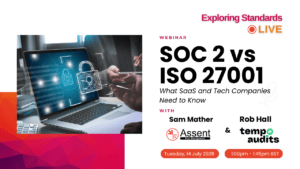

Webinar – SOC 2 and ISO 27001
What are the key differences between SOC 2 and ISO 27001, and how can organisations decide which framework is right for them?
In our latest webinar, we were joined by Sam from Assent Risk Management and Rob Hall from Tempo Audits to explore how the two frameworks compare, what auditors look for and how organisations can prepare.
The discussion covered why businesses pursue certification or SOC 2 reports, the different approaches to auditing and some of the common challenges organisations face when implementing information security frameworks.
Understanding the similarities and differences
SOC 2 and ISO 27001 are both risk-based frameworks focused on information security. They share many of the same controls, with around 70–80% considered similar across the two.
Examples include multi-factor authentication, access control, vulnerability management, incident response and business continuity. Both also require documented policies and procedures to help protect business information.
The main difference is their approach. ISO 27001 is built around a management system, with an emphasis on consistent processes, risk management, internal audits, management reviews and continual improvement.
SOC 2 focuses more on the selection and effectiveness of individual controls, looking at whether they are appropriate and operating consistently.
Why do organisations choose SOC 2 or ISO 27001?
Sam and Rob explained that the decision is often commercially driven. Organisations may pursue certification or a SOC 2 report because a customer, tender or supply chain requirement makes it necessary.
The location of an organisation’s customer base can also influence the choice. European businesses are more likely to be asked for ISO 27001, while US customers often request SOC 2. Some organisations may eventually need both as they grow.
Rob also highlighted the importance of understanding exactly what customers require before choosing a route. This can affect the scope and cost of an assessment, including the accreditation requirements for ISO 27001 or the Trust Services Criteria selected for SOC 2.
SOC 2 has five Trust Services Criteria: security, confidentiality, availability, processing integrity and privacy. Including additional criteria means more controls to implement and audit, so organisations should understand which are actually required.
What do auditors look for?
The audit processes for ISO 27001 and SOC 2 are quite different.
An ISO 27001 audit assesses whether an organisation meets the requirements of the standard at the time of the assessment. It typically involves two stages, with auditors looking for evidence that the relevant clauses and controls have been implemented effectively.
SOC 2 takes a retrospective approach. Rather than assessing controls at a single point in time, it looks at whether they have operated consistently over an agreed period, usually between three and twelve months.
Rob explained that organisations should be careful about moving straight into a Type 2 audit without checking their readiness. If controls haven’t been operating for the full observation period, this can lead to exceptions in the final report. A Type 1 assessment or pre-assessment can help identify issues before the observation period begins.
Preparing for a successful assessment
Sam recommended starting by reviewing existing documentation and processes to understand what is already in place. A gap analysis can then help identify what is missing, the work involved and the resources needed to achieve compliance.
Organisations should also consider their specific risks, the type of data they hold and any customer, legal or regulatory requirements when selecting appropriate controls.
For ISO 27001, the Statement of Applicability is an important document. It maps the Annex A controls and explains which have been included or excluded, helping demonstrate how the organisation has approached information security.
For SOC 2, Rob advised asking the auditor which control framework they use and making sure the required evidence is ready in advance. This could include records such as employee onboarding examples.
Common challenges to avoid
Both speakers highlighted the risk of underestimating the time and effort involved in implementing these frameworks.
ISO 27001 and SOC 2 are technical and detailed, and organisations familiar with standards such as ISO 9001 may not appreciate the additional work involved. Creating too much documentation can also make a management system difficult to maintain.
Other common challenges include:
- Misinterpreting requirements that are not always prescriptive.
- Leaving implementation until a customer or tender makes it urgent.
- Not gathering enough evidence ahead of an assessment.
- Attempting implementation without the right experience or support.
Sam and Rob emphasised the value of working with an experienced consultant or ensuring a competent internal auditor reviews the system before the external assessment. Good preparation can make the audit process much smoother.
Watch the webinar
Watch the full webinar with Sam and Rob Hall to explore the differences between SOC 2 and ISO 27001, what to consider when choosing a framework and how to prepare for a successful assessment.
This summary was generated using AI based on the webinar transcript.

