
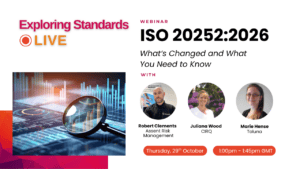

What does the latest revision of ISO 20252 mean for market research organisations, and how can they prepare for the changes?
In this webinar, hosted by Assent Risk Management, we were joined by Rob Clements from Assent, Juliana Wood from CIRQ and Marie Hense from Toluna to explore the updates to the international standard for market, opinion and social research.
The discussion focused on the new requirements around artificial intelligence, information security and panel management, alongside practical advice on preparing for transition.
Understanding the changes to ISO 20252
Published on 1 September 2026, the revised standard retains much of the existing structure but introduces several important updates.
One of the most significant changes is the increased focus on artificial intelligence. New requirements address the ethical use of AI, transparency and appropriate human oversight. Organisations need to understand where AI is being used within their research activities, how it affects their services and how this is communicated to clients.
The revision also strengthens information security requirements and makes legal and regulatory obligations more clearly identifiable. Internal audit requirements have also been expanded.
There are changes to the annexes too, with the previous six annexes becoming seven. Sampling and panel management are now covered separately, with new Annex G introducing requirements around panel transparency, data fraud, data quality, automation and sample blending.
What do the changes mean in practice?
Rob explained that organisations should start by reviewing how they currently operate and identifying which requirements apply to their services.
Rather than creating documentation simply to satisfy the standard, businesses should build on existing processes and update them where necessary.
Some of the key areas to consider include:
- Reviewing policies, procedures, training materials and client-facing documents.
- Identifying where AI is used, including within existing software and research tools.
- Checking the organisation’s scope and Statement of Applicability.
- Making sure employees, contractors and subcontractors understand the updated requirements.
- Reviewing recent projects to check that processes are being followed.
- Using internal audits and management reviews to identify outstanding actions.
Rob also highlighted the importance of being transparent with clients about AI use, without needing to disclose proprietary processes or trade secrets.
How is Toluna preparing for the transition?
Marie shared how Toluna is approaching the changes ahead of its planned 2028 recertification.
As a global organisation, Toluna needs to coordinate the transition across different teams, functions and locations. Its approach is therefore phased, starting with an assessment of the revised requirements before working with around 20 quality champions to identify changes within their respective teams.
Marie highlighted the importance of setting clear milestones, documenting changes and allowing updated processes time to become established before an audit.
Toluna aims to complete implementation at least two months before an audit, giving the organisation time to demonstrate that the new requirements are working in practice.
The new AI requirements are also particularly relevant to Toluna, as it continues to introduce AI across its operations. Clearer expectations around governance, transparency and human oversight help ensure these considerations are built into its processes.
When should organisations transition?
A transition period of around 24 to 36 months is expected for organisations moving from ISO 20252:2019 to the 2026 edition.
CIRQ expects to be ready to support transition audits and new certifications from March 2027. Organisations should speak to their certification body about its arrangements and plan the transition alongside existing surveillance or recertification audits where appropriate.
Watch the webinar
Watch the full webinar with Rob Clements, Juliana Wood and Marie Hense to explore the ISO 20252:2026 changes in more detail and hear their advice on preparing for transition.
This summary was generated using AI based on the webinar transcript.

