
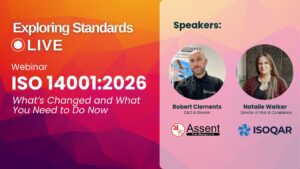

What does the latest revision of ISO 14001 mean for organisations, and what should you be doing to prepare?
In our latest webinar, we were joined by Robert Clements from Assent Risk Management and Natalie Walker from ISOQAR to explore the changes introduced in ISO 14001:2026 and what they mean for organisations.
The discussion covered the key updates to the standard, including environmental conditions, life cycle thinking and planning for change, as well as practical steps for preparing for the transition.
Understanding the changes to ISO 14001:2026
Published on 15 April 2026, the latest version of ISO 14001 is an evolution of the 2015 standard rather than a complete rewrite.
The overall structure and purpose remain familiar, but the updated version brings clearer requirements, more consistent terminology and a stronger focus on current environmental priorities.
Robert highlighted several areas organisations should review, including life cycle thinking, environmental aspects and impacts, risks and opportunities, and management responsibilities.
There is also a new requirement for planning changes, alongside clearer expectations around management reviews and continual improvement.
Environmental conditions and life cycle thinking
One of the key changes is the requirement to explicitly consider the environmental conditions in which an organisation operates.
This includes factors such as climate-related risks, local pollution, access to natural resources, water and energy availability, and impacts on biodiversity and ecosystems.
Organisations will need to demonstrate how these conditions have influenced their objectives, risks and controls.
The updated standard also strengthens the focus on life cycle thinking, making it more prominent when defining the scope of an environmental management system, planning operations and making procurement decisions.
This means considering environmental impacts across the full life cycle of products and services, from purchasing and supplier selection through to use and disposal.
For many organisations, these activities may already be happening. The key is making sure they are properly considered, communicated and evidenced.
What does the transition mean for organisations?
Robert recommended starting with a review of existing documentation and processes, identifying where updates are needed to meet the revised requirements.
Organisations should also revisit their environmental aspects and impacts assessment, review responsibilities within the management system and make sure employees understand their roles.
Internal audits and management reviews will be important in checking whether changes have been implemented effectively and whether the system continues to meet its objectives.
Natalie also emphasised the importance of planning an orderly transition with the certification body, rather than leaving everything until the last minute.
Transition dates and certification
The transition will take place over a three-year period, giving organisations time to move to the updated standard.
Natalie explained that certification bodies must complete their own accreditation migration before they can issue UKAS-accredited certificates to ISO 14001:2026. The webinar discussed this process taking place towards the end of 2026, with certification against the new version expected to become available from late December or early January.
For organisations already certified to ISO 14001:2015, the transition deadline discussed was 31 October 2027. Recertification before this date can still take place against the 2015 version, while recertification after it must be against the 2026 version.
Both speakers recommended starting the transition early to avoid unnecessary pressure and last-minute changes.
Preparing for implementation and certification
For organisations new to ISO 14001, Natalie strongly recommended implementing the 2026 version rather than starting with the 2015 standard and having to make changes later.
Robert explained that a gap analysis is a useful starting point, helping organisations understand what they already have in place and where improvements are needed.
Existing policies, processes and environmental initiatives can often be used as part of the management system, rather than creating unnecessary new documentation.
Organisations can also seek support through consultancy, internal audits and training. Assent can help with implementation and transition planning, while ISOQAR offers dedicated ISO 14001:2026 transition training and certification support.
The key is to understand the changes, make use of existing good practice and build a realistic plan for moving to the updated standard.
Watch the webinar
Watch the full webinar with Robert Clements and Natalie Walker to explore the changes to ISO 14001:2026, understand the transition requirements and find out how to prepare your environmental management system.
This summary was generated using AI based on the webinar transcript.

