
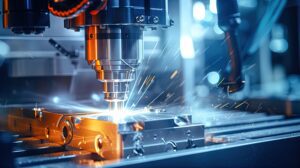

CNC machining is an important technique in aerospace manufacturing. When tolerances are measured in microns and failure is not an option, the combination of computer-controlled machining and disciplined management systems is what separates dependable suppliers from expensive risks. Understanding CNC machining in an AS9100 context is therefore not a technical curiosity; it is a compliance and assurance issue with direct commercial consequences.
What Is CNC Machining?
CNC (Computer Numerical Control) machining is a manufacturing process where machine tools such as mills, lathes, and grinders are controlled by programmed software rather than manual operation. Design data, typically from CAD/CAM systems, is converted into machine instructions that drive cutting tools with extreme accuracy and repeatability.
For aerospace manufacturers, CNC machining is fundamental to producing components such as brackets, housings, engine parts, landing gear components, and precision fittings. These parts often involve complex geometries, tight tolerances, specialist materials, and stringent traceability requirements. CNC machining provides the control needed, but control alone is not assurance. That is where standards come in.
Why CNC Machining Is Critical in the Aerospace Sector
The aerospace sector is unforgiving by design. Components are exposed to fatigue, vibration, thermal stress, and long service lives, often in safety-critical applications. A single nonconforming part can ground aircraft, trigger regulatory scrutiny, or destroy supplier confidence overnight.
This is why the aerospace supply chain demands more than competent machining. They expect evidence of controlled processes, qualified personnel, validated programs, maintained equipment, and disciplined change management.
How AS9100 Applies to CNC Machining Operations
AS9100 builds on ISO 9001 but adds aerospace-specific requirements that are directly relevant to CNC machining environments.
Process control is central. CNC programs must be controlled documents, subject to change management, validation, and approval. Tooling, fixtures, and inspection equipment must be defined, maintained, and verified. First Article Inspection (FAI) is not optional theatre; it is a formal demonstration that machining processes can consistently produce conforming parts.
Read more: Understanding the Process Effectiveness Assessment Report (PEAR) in AS9100 Audits
Risk-based thinking is another differentiator. In an AS9100-aligned machine shop, risks such as tool wear, machine drift, operator intervention, software updates, and material substitution are identified, assessed, and controlled. This is a cultural shift from “the machinist knows best” to “the system proves it works”.
Configuration management also bites hard in CNC machining. Seemingly small changes, such as a revised cutting path, a different insert grade, or a CAM software update, can materially affect part conformity. AS9100 expects these changes to be evaluated, approved, and communicated, not quietly absorbed on the shop floor.
The Role of ISO 9001 in CNC Machining
ISO 9001 provides the backbone. It establishes requirements for documented processes, competence, calibration, corrective action, internal audits, and management review. For CNC machining businesses outside aerospace, ISO 9001 is often the first step towards disciplined operations.
In aerospace supply chains, ISO 9001 alone is rarely sufficient, but it remains a solid foundation for AS9100.
Many machining businesses struggle when stepping up to AS9100 due to weak document control, informal training records, and reactive nonconformance management. Exactly where Assent’s expert AS9100 Consultants can help.
Common Questions Manufacturers Ask About CNC Machining and AS9100
Question: Does AS9100 only apply to large aerospace manufacturers:
Answer: No, it does not! Any organisation machining parts destined for aerospace applications, directly or indirectly, may be expected to operate to AS9100, regardless of size.
Question: Does CNC machining software and programs need to be validated?
Answer: In an aerospace context, YES. Validation does not mean over-engineering; it means demonstrating that the program produces conforming parts under defined conditions and that changes are controlled.
Question: Does AS9100 require 100% inspection?
Answer: There is a persistent confusion about inspection. AS9100 does not require 100% inspection of all CNC-machined parts, but it does require a risk-based approach, supported by capable processes, appropriate SPC (Statistical Process Control) where applicable, and meaningful use of inspection data rather than post-hoc box ticking.
How Assent Risk Management Supports Aerospace CNC Machining Businesses
At Assent we understand that compliance in the Aerospace supply chain requires more than a generic quality management expert. That’s why our specialist aerospace practice, Cleared for Audit, consists of consultants with real industry, engineering, military and certification experience, with qualifications to match.
We understand CNC machining not as an abstract process, but as a lived operational reality with commercial pressures, customer audits, and technical constraints.
We support CNC machining organisations with AS9100 and ISO 9001 implementation, internal audits that actually add value, gap analysis prior to certification or customer audits, and pragmatic training for managers and engineers who need to operate the system, not just explain it.Adopting AS9100 can open up a new world of opportunities within the aerospace supply chain.
Contact us to get started!